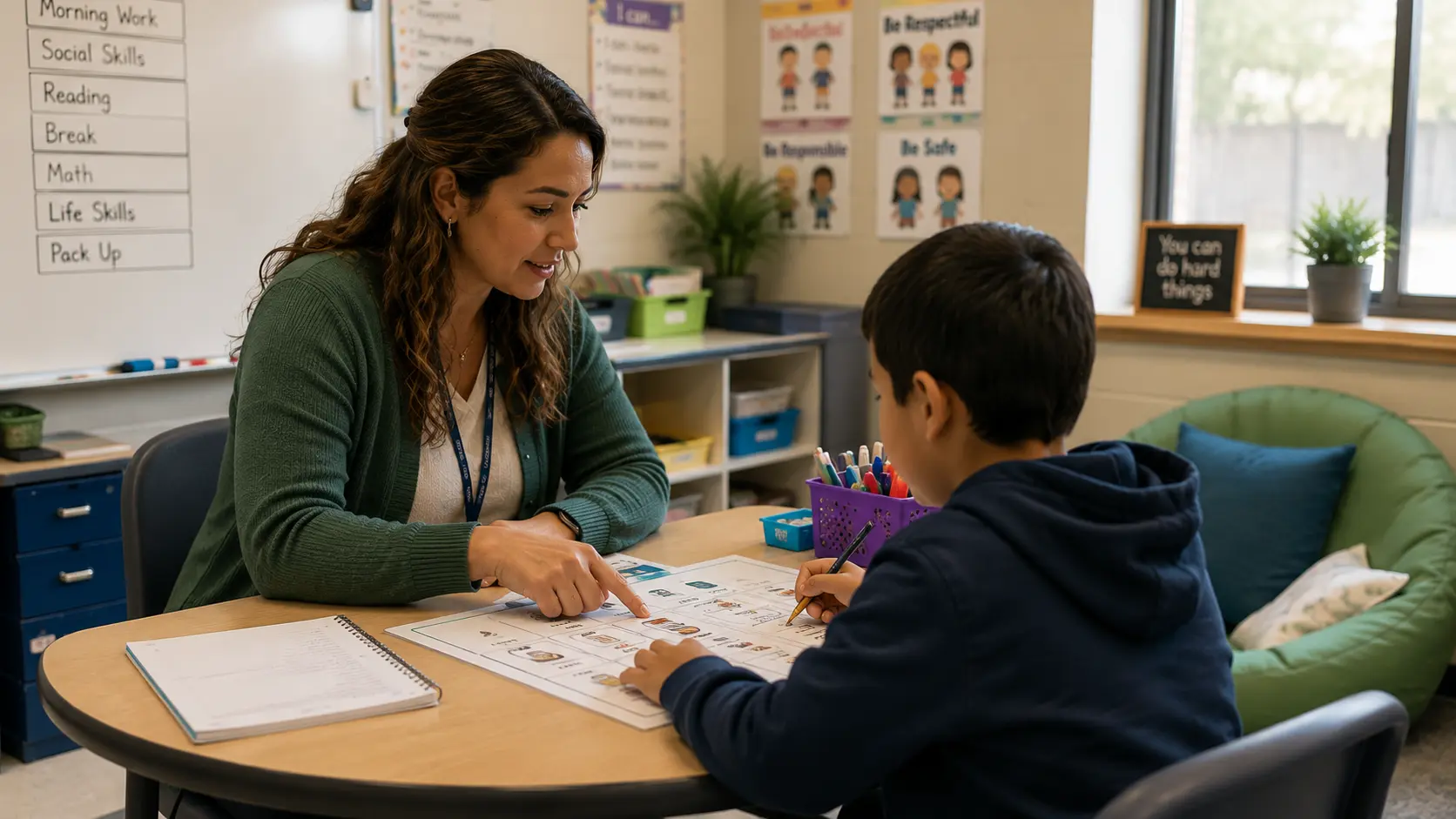

When a special education position goes unfilled, the consequences are not abstract. A student with an Individualized Education Program loses access to the services that the plan legally requires. A paraprofessional gets placed in a room they are not trained to manage. A general education teacher absorbs a caseload that they cannot realistically serve. And somewhere in the district's legal department, a compliance clock starts ticking.
Special education is not just the hardest teaching area for staff. It is the one where staffing failure carries direct legal exposure under the Individuals with Disabilities Education Act. Every unfilled position is not only a classroom gap. It is a potential violation of a federal mandate.
That is what makes special education recruiting categorically different from general educator hiring. And it is why the districts that treat it as the same problem with the same tools consistently fall behind the ones that do not.
If you are also working through general educator shortages, start with The Teacher Shortage Will Not Fix Itself: How to Hire Educators in a Broken Market. This article addresses the specific, compounded challenge of finding special education candidates in a market where almost no one is looking.
 The table below outlines the core differences between recruiting for general education positions and special education roles.
Understanding these differences is the starting point for building a sourcing approach that can actually produce results.
 The candidates who can fill these roles are not passively searching job boards. They are either already employed, enrolled in a preparation program, or considering leaving the field entirely. Reaching them requires going to where they are, not waiting for them to come to you.
The following sourcing channels, used in combination, consistently outperform standard job posting approaches.
The candidates who can fill these roles are not passively searching job boards. They are either already employed, enrolled in a preparation program, or considering leaving the field entirely. Reaching them requires going to where they are, not waiting for them to come to you.
The following sourcing channels, used in combination, consistently outperform standard job posting approaches.
Why This Shortage Runs Deeper Than Any Other
Special education teacher shortages have existed in some form since the U.S. Department of Education began tracking shortage areas in 1990. Every year, special education appears on more state shortage lists than any other subject area. What changed in the years following the pandemic was the severity. According to the U.S. Department of Education's Institute of Education Sciences, special education vacancies during the 2021-22 school year were approximately twice as likely to go unfilled as vacancies in other teaching areas. The pipeline of new special educators entering the workforce did not keep pace with attrition. Dual-certified teachers, those holding both general and special education credentials, began moving into general education positions at higher rates, removing supply from the most constrained end of the market without technically leaving the profession. The result is a talent pool that is not just small. It is actively shrinking relative to the number of students it is expected to serve. The Scale in 2026 The numbers frame the challenge clearly. According to the National Center for Education Statistics, 74% of elementary and middle schools and 66% of high schools reported difficulty filling special education vacancies with a fully certified teacher during the 2024-25 school year. This is the highest difficulty-to-fill rate of any teaching category surveyed, exceeding even mathematics and science shortages. Brookings Institution research published in November 2025, drawing on data from seven states, found that special educator staffing challenges are highly context-specific. Attrition patterns differ substantially not only between states but also between school types within the same district. Urban high-poverty schools face different shortages than rural districts. Districts relying on one-size-fits-all recruiting strategies are, by design, solving the wrong problem. This matters because it means generic job postings are particularly ineffective for special education roles. The candidate you need is specific. The sourcing strategy needs to match.What Makes Special Education Recruiting Different
The table below outlines the core differences between recruiting for general education positions and special education roles.
| Dimension | General Education | Special Education |
| Candidate pool size | Small to moderate | Extremely small |
| Certification complexity | Single credential | Often dual certification required |
| Legal compliance stakes | Low to moderate | High IDEA mandates active IEPs |
| Candidate motivation drivers | School culture, salary, location | Student impact, admin support, caseload size |
| Typical sourcing channels | Job boards, university pipelines | Specialized associations, direct university outreach |
| Time-to-fill average | 4 to 8 weeks | 8 to 16 weeks or longer |
| Impact of unfilled position | Instructional gap | Legal, instructional, and equity gap simultaneously |
Where Special Education Candidates Actually Are
The candidates who can fill these roles are not passively searching job boards. They are either already employed, enrolled in a preparation program, or considering leaving the field entirely. Reaching them requires going to where they are, not waiting for them to come to you.
The following sourcing channels, used in combination, consistently outperform standard job posting approaches.
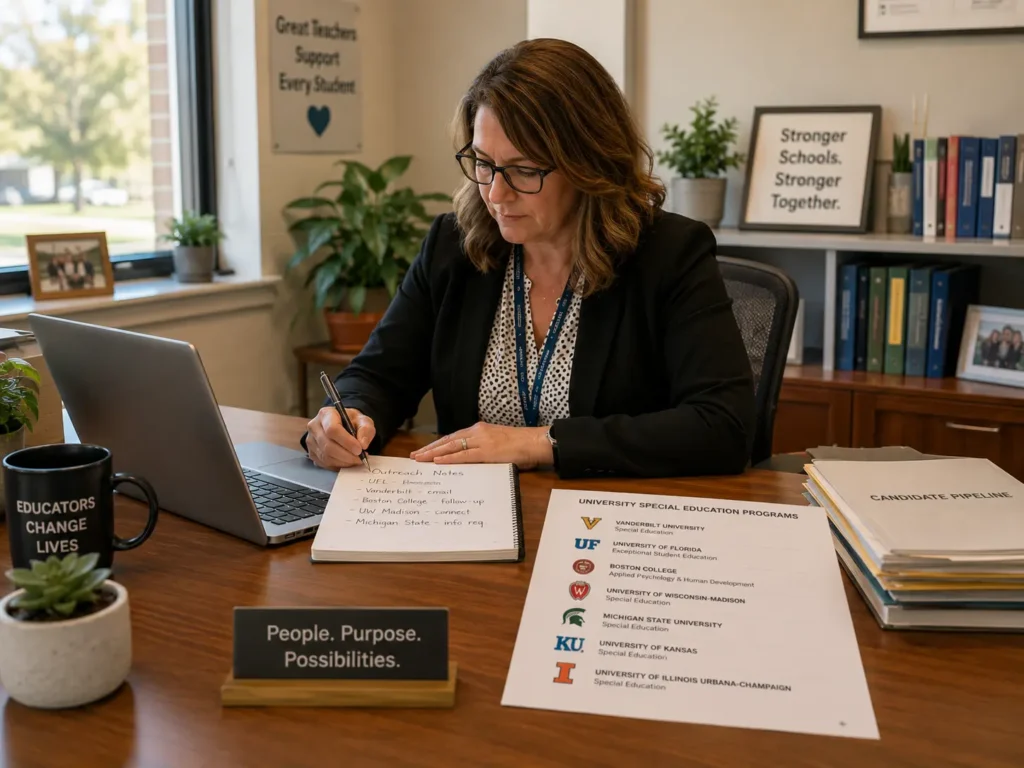
- University special education programs. Partner with educator preparation programs that offer special education licensure. Student-teacher placements are the most direct pipeline for new graduates. Districts that host placements and offer employment conversations before graduation have a documented advantage over those that post open roles in August.
- The Council for Exceptional Children. The CEC is the primary professional association for special educators in the United States. Its job board, state chapter networks, and annual conference represent the most concentrated access point to credentialed special education professionals nationally.
- Paraprofessional conversion pipelines. Many districts employ paraprofessionals who work daily alongside students with disabilities and are actively interested in becoming certified special educators. A structured grow-your-own program, with tuition support tied to service commitments, converts existing district employees into licensed special educators. This is among the most cost-effective pipelines available and is systematically underused.
- Out-of-field teachers seeking recertification. Teachers who hold general education credentials and have expressed interest in special education certification represent a parallel pipeline. Districts that offer mentorship, tuition assistance, and structured professional development for this group consistently expand their supply without competing in an already constrained external market.
- National search, not local posting. Because the candidate pool is national in scope, sourcing should be too. Limiting special education searches to local applicants means accepting the constraints of a local market that almost certainly cannot meet demand.
- Targeted outreach to historically Black colleges and universities and minority-serving institutions. HBCU special education programs produce a disproportionate share of diverse special educators who are significantly underrepresented in district outreach strategies. Establishing recruitment relationships with these institutions expands both the pipeline and the diversity of the candidate pool.
- Return-to-field campaigns. Former special education teachers who left the classroom due to burnout, administrative burden, or caseload pressure do not always leave the profession permanently. Direct outreach to former employees, combined with concrete improvements in working conditions and caseload management, brings experienced candidates back into consideration.
The Compliance Dimension You Cannot Ignore
Special education recruiting is not only a staffing challenge. It is a legal one. Under IDEA, every student with a qualifying disability is entitled to a Free Appropriate Public Education. When a certified special education teacher is unavailable to implement an IEP, the district is not merely short-staffed. It is potentially non-compliant with a federal mandate that carries enforcement consequences. This means that special education recruiting must be treated as a compliance function, not only an HR function. Timelines matter more. Interim coverage plans must be in place. And credentialing standards cannot be quietly lowered in ways that expose the district to legal challenge. For a detailed look at the compliance requirements surrounding educator credentials, see our article Teacher License Verification: The Compliance Step Schools Handle Badly.What to Watch for in Special Education Candidate Interviews
Screening for special education candidates requires attention to traits that go well beyond certification and subject knowledge. The following signals distinguish candidates who will stay from those who will not make it through the first year.- Specific, concrete descriptions of how they manage IEP documentation and caseloads, vague answers suggest limited real-world experience
- Evidence of how they communicate with families, including difficult conversations about progress and services
- Their approach to collaboration with general education teachers and paraprofessionals
- How they describe the administrative burden of the role, candidates who are surprised by it in the interview will be overwhelmed by it in practice
- What kind of administrative support do they need to function well, and whether your district can provide it
- Whether they have a clear understanding of the disability categories they will be serving and the specific intervention approaches required