

What the Research Says About Why Teachers Leave
Teachers identify support from their administrator as a stronger predictor of their decision to stay than their own workload levels. This means that hiring a teacher into a school with a weak principal, or hiring a teacher whose expectations of administrative support do not align with the school's actual culture, is a retention risk that no onboarding program can fully compensate for. The hiring conversation is the place to get this right. It is also the place where most districts get it wrong.
What Most Hiring Conversations Actually Communicate
The Interview Questions That Predict Longevity

The following questions are not designed to catch a candidate in an inconsistency. They are designed to surface the real person who will or will not be sitting in that classroom in year three. On resilience and realistic job preview:
- "What has been the most difficult aspect of your teaching career so far, and how did you work through it?"
- "If a student's behavior disrupted your class consistently for two weeks, walk me through how you would respond, including what you would expect from administration."
- "Describe the school environment that has brought out your best work as a teacher."
- "What does good administrative support look like to you, specifically?"
- "Tell me about a time when you disagreed with a decision made at the school level. What did you do?"
- "What would you want to know about the principal before you accepted this role?"
- "Where do you see yourself professionally in five years, and how does this role fit into that trajectory?"
- "What would have to be true about a school for you to be happy and effective there three years from now?"
- "What do your former students and colleagues say about working with you?"
What to Tell Candidates Before They Accept
The following information should be communicated honestly to every finalist before an offer is extended. It is not a risk to share it. It is the condition for hiring someone who will stay.
- The realistic daily schedule, including before and after school expectations
- The behavior management reality of the student population not a sanitized version
- The administrative communication style of the principal
- The turnover history of this specific role, and why previous teachers left if known
- The professional development and mentorship support available in the first year
- The timeline to tenure and the specific criteria used for evaluation
- Any structural constraints the teacher will face: class size, resource availability, planning time
The First-Year Investment That Changes Five-Year Retention
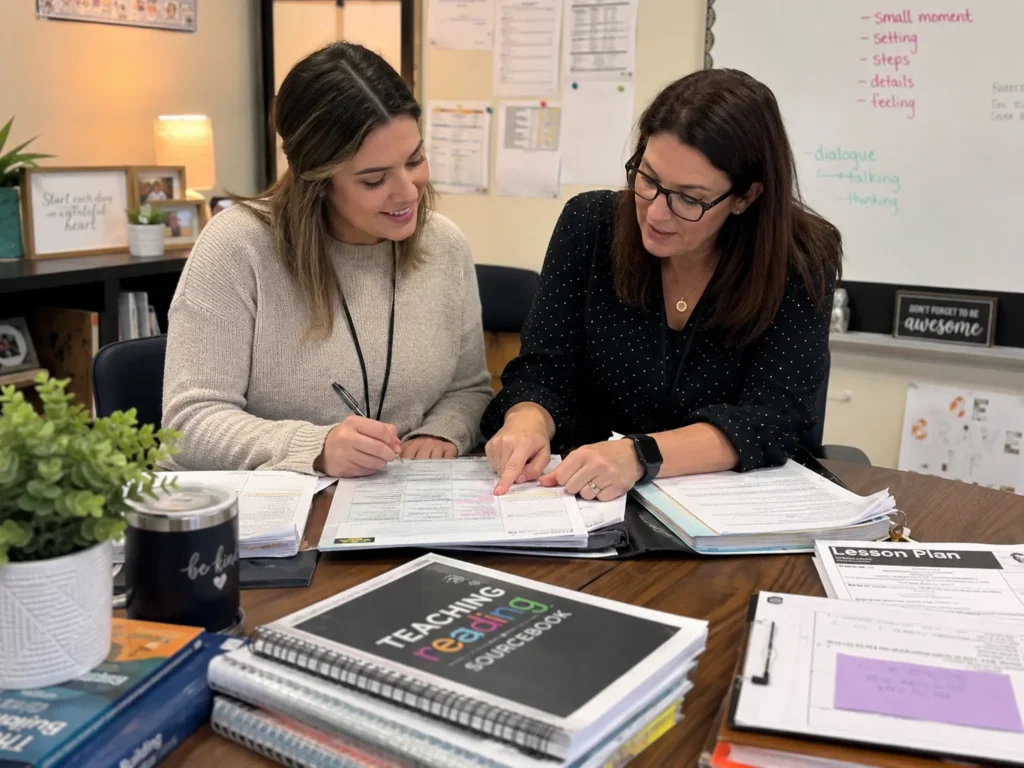
Research consistently shows that induction programs with structured mentorship, collaboration time, and regular check-ins significantly reduce early-career attrition. The FASA 2025 retention analysis cites a reduction in early-career attrition of up to 30% among teachers in high-quality induction programs compared with those without structured support. Quality matters here, not just existence. An induction program that requires new teachers to attend a two-day orientation in August and assigns them a mentor they see once a semester is not an induction program. It is a checkbox. The following elements distinguish functional induction from compliance induction:
- A mentor assigned by subject area, grade level, or specific professional need, not by availability
- Protected collaboration time is built into the schedule, not layered on top of it
- Principal check-ins at 30, 60, and 90 days with specific agenda items around what is working and what needs adjustment
- A process for the new teacher to raise concerns that does not require them to go directly to their evaluator
- A clear articulation, made in writing, of what the first-year evaluation process will look like and what success means
The Hiring-Retention Feedback Loop
Every teacher who leaves before year three is an exit interview waiting to be read backward into the hiring process. The most common themes in early-career exit interviews, "I didn't understand what I was getting into," "I felt unsupported," "the role wasn't what was described," all trace to something that could have been addressed in the hiring conversation. Districts that build this feedback loop review early exits against the hiring files of the teachers who left, asking what the interview process communicated versus what the teacher found consistently identify patterns that allow them to change both their candidate screening and their candidate communication.
The teacher who stayed for eight years was not just a good fit. She was hired by a process that found her, told her the truth, assessed the right things, and gave her a reason to stay before she needed one. For more on how the same principles apply to special education and high-need roles, see our article Special Education Recruiting: How to Find the Candidates No One Else Can. And for the principal's role in all of this, see Hiring a Principal: What School Districts Do Wrong and Why Good Leaders Walk Away.