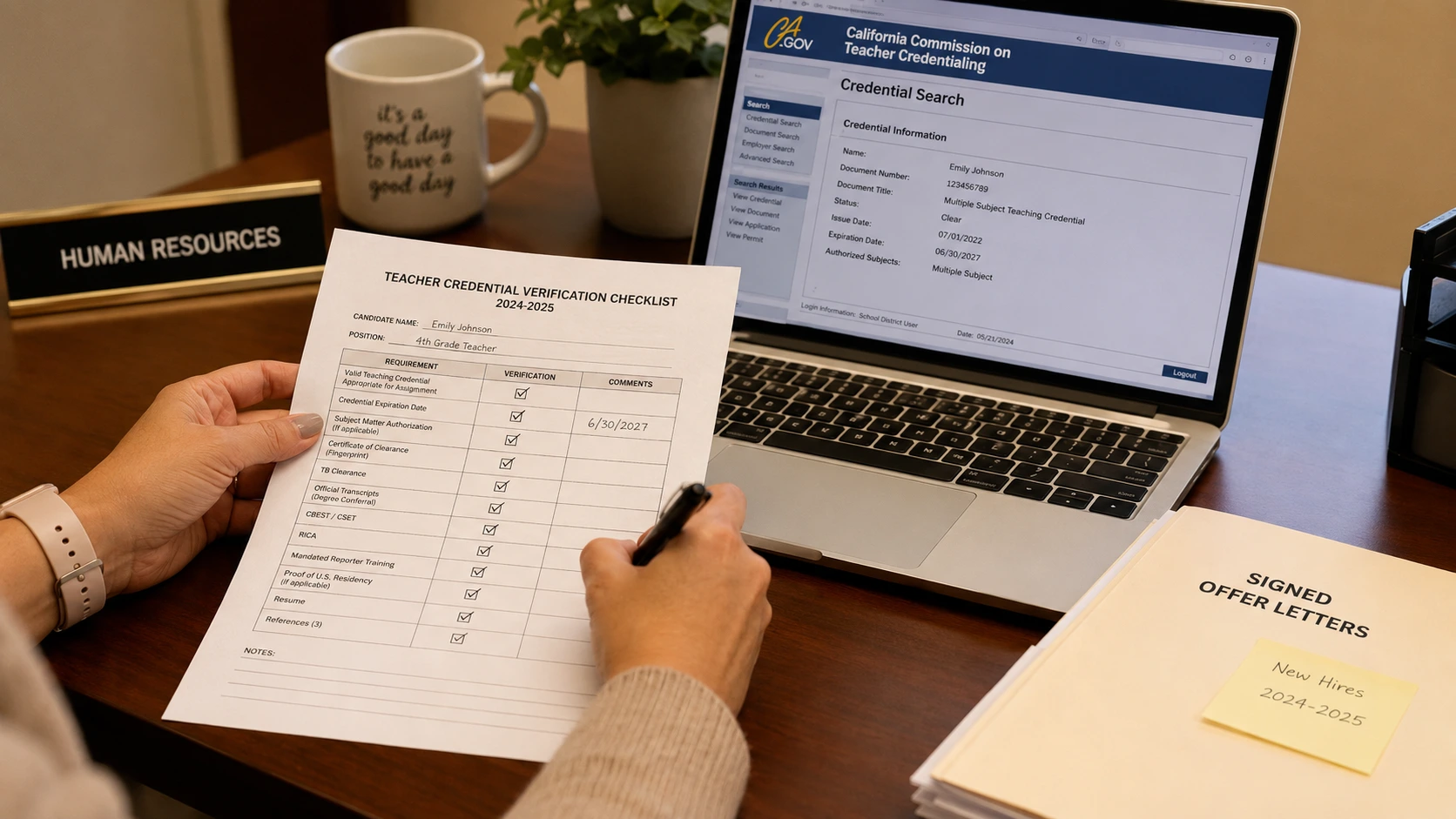

The teacher passed the interview. The references came back strong. The principal liked her. HR extended the offer, and she accepted. She started on the first day of school.
Six weeks later, the district discovered she had been teaching on an emergency permit in her previous state because her original credential had lapsed. It had never been reinstated. The district was now in its second month of non-compliance with state certification requirements for that classroom, was exposed to a state audit, and faced the question of whether the six weeks of instruction she had delivered counted toward their Title I reporting obligations.
Nobody checked. Not because the district lacked a verification policy. Because the policy said to verify, the form said "verified," and nobody had actually checked the state licensing database to confirm the status of the credential before the contract was signed.
This is the most common version of a teacher license verification failure. It is not a policy failure. It is an execution failure within a system that was designed to appear to be working.
 The following elements constitute a thorough educator license verification process. Most district HR departments complete three or four of these. Full compliance requires all of them.
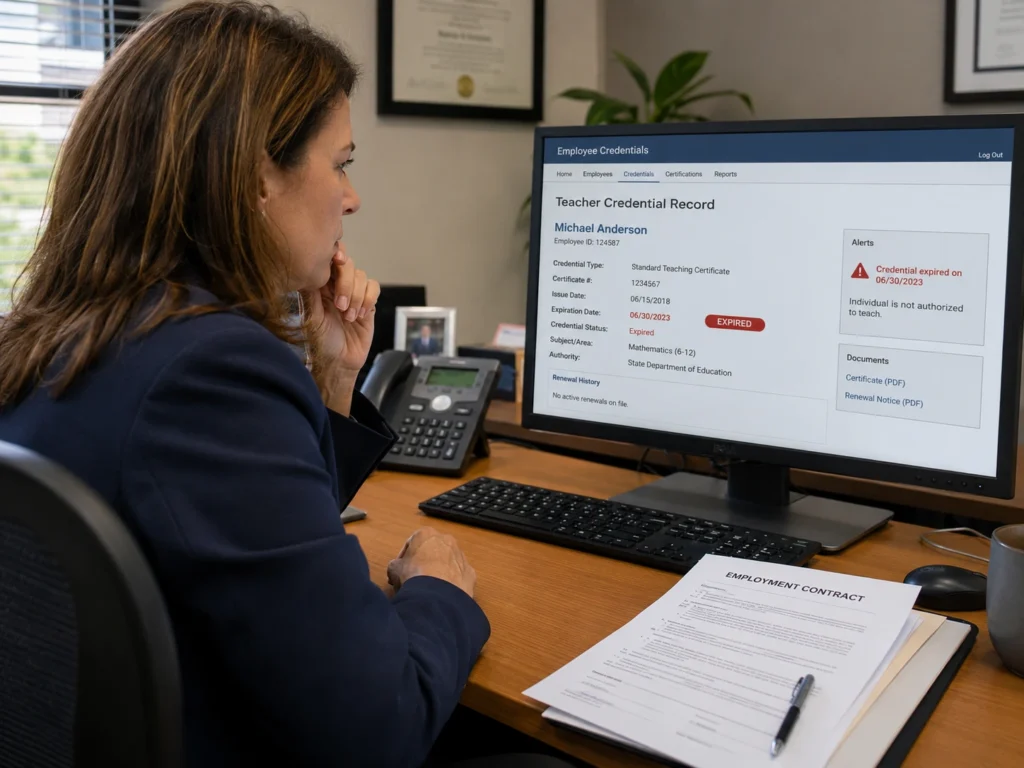 The following failure points appear in district compliance audits with notable consistency.
Why Verification Is Harder Than It Looks
Teacher certification in the United States is not federally standardized. Every state issues its own licenses, maintains its own databases, defines its own subject area endorsements, and sets its own renewal schedules. A teacher licensed in Texas may hold credentials that do not automatically transfer to Illinois. A candidate who was certified in New York may have allowed that license to lapse after three years in a private school that did not require it. The National Association of State Directors of Teacher Education and Certification (NASDTEC) maintains the Educator Information System, a database used by participating states to track educator certification status and disciplinary actions across state lines. Fifty states plus the District of Columbia participate. But access to that system does not eliminate the verification burden. It centralizes one layer of it. The underlying data still comes from individual state agencies, each with different update cycles, different definitions of active and lapsed credentials, and different processes for out-of-state applicants. A recruiter or HR department that verifies only that a candidate appears in a state licensing lookup has completed the first step. They have not verified subject area endorsement, current renewal status, any restrictions attached to the license, or whether a disciplinary flag exists in another state.What Complete Verification Actually Requires
The following elements constitute a thorough educator license verification process. Most district HR departments complete three or four of these. Full compliance requires all of them.
- Confirm active status in the hiring state's licensing database. This is the minimum. It does not substitute for the steps below.
- Verify specific endorsements match the assignment. A teacher may hold a valid license but not the endorsement for the subject or grade level they are being hired to teach. A licensed teacher without a special education endorsement cannot legally deliver special education services. This mismatch is more common than districts track.
- Check the NASDTEC EIS for disciplinary records. The Educator Information System contains records of license revocations, suspensions, and disciplinary actions from participating states. A candidate whose credential was revoked in one state may have obtained a new credential in another. Without checking EIS, that history is invisible.
- Verify out-of-state credentials independently. Candidates who trained or taught in other states may be presenting credentials issued by a different licensing authority. Verify through the issuing state's official database, not only through what the candidate provides.
- Confirm credential renewal dates. A credential that is valid today may expire before the end of the school year. Districts that hire without confirming the renewal timeline can find themselves mid-year with a teacher whose credential lapses during the contract period.
- Document everything with timestamps. In the event of a state audit or a parent complaint, the district's ability to demonstrate that verification was completed before the hire date, not after, is the difference between a compliance finding and a closed case.
The Consequences of Getting This Wrong
The consequences of employing a teacher without verifying credentials fully are not theoretical. Under Title I of the Every Student Succeeds Act, schools receiving Title I funds must certify that teachers meet state certification requirements for their assignments. According to the U.S. Department of Education's Title I requirements, districts that cannot demonstrate compliance may face monitoring, corrective action plans, and, in sustained cases, loss of Title I funding. For districts where Title I represents a significant portion of the operating budget, the financial exposure is real. Under the Individuals with Disabilities Education Act, noncompliance resulting from an uncredentialed special education teacher can trigger due process complaints from parents and, where IEP services were not delivered as written, compensatory education orders requiring the district to fund additional services at its own expense. According to data tracked by the Learning Policy Institute, at least 411,549 teaching positions in 2025 were either vacant or filled by teachers not fully certified for their assignment. Every one of those positions represents a verification decision that was either skipped, shortcut, or made based on incomplete information. The district that discovers the problem after the hire is in a worse position than the one that caught it at the offer stage.Where Districts Most Commonly Fail
The following failure points appear in district compliance audits with notable consistency.
- Verifying only the candidate's primary license without checking subject area endorsements
- Accepting a copy of a credential from the candidate rather than verifying directly in the state database
- Failing to check the NASDTEC EIS for out-of-state history
- Completing verification after the start date rather than before the contract is signed
- Not tracking renewal expiration dates for current staff during the school year
- Using different verification standards for long-term substitutes than for permanent hires
- Relying on a verbal confirmation from a previous district without primary source verification
Building a Verification System That Actually Works
A functional educator license verification process has three characteristics: it is primary-source-based, it runs before the start date, and it is documented in a way that can be produced during an audit. The following structure reflects best practice for districts of any size.- Designate one person in HR with explicit ownership of credential verification for every hire
- Build a verification checklist that maps to the specific endorsements required for each posting
- Create a direct bookmark to your state's official educator licensing lookup and require its use for every hire
- Subscribe to NASDTEC EIS access and require an EIS check for any candidate who has lived or taught in another state
- Set calendar reminders to audit current staff renewal dates annually, before the end of the prior school year
- Retain verification documentation for the duration of the employee's tenure plus three years